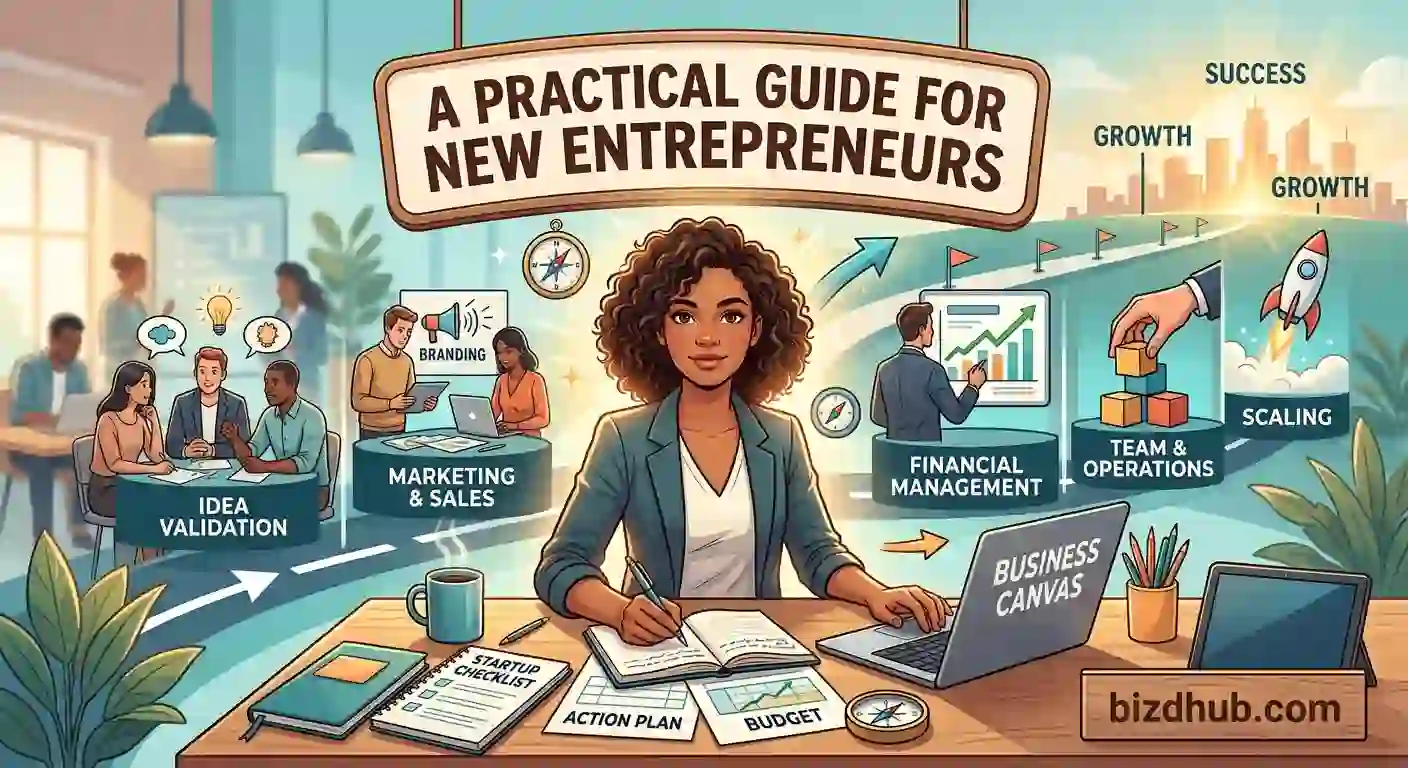
Starting a business can be exciting, but turning an idea into a sustainable company requires much more than enthusiasm. New founders must understand customers, evaluate opportunities, manage limited resources, and make decisions without having perfect information. These realities create startup challenges that can affect everything from funding and marketing to operations and hiring. A practical approach is to validate an opportunity, understand the market, build a realistic business model, and remain willing to adapt as evidence changes. Entrepreneurs who combine disciplined planning with entrepreneurial thinking are better prepared to handle uncertainty and build businesses that can grow sustainably.
Understand the Real Challenges of Starting a Business
Entrepreneurship involves uncertainty. A promising idea can fail if customers do not have a strong enough reason to pay for it, while a simple idea can succeed when it solves a clear and valuable problem.
Common startup challenges include limited capital, uncertain demand, strong competition, inconsistent cash flow, difficulty finding customers, and the need to make important decisions with limited information. New founders may also underestimate how much time is required for sales, customer support, administration, compliance, and day-to-day operations.
The first step is therefore not launching quickly. It is understanding whether the opportunity deserves your time and money.
How to Assess Your Opportunities Before Starting a Business
Before investing significant resources, evaluate the opportunity from several angles.
1. Identify a Real Customer Problem
Ask who has the problem, how frequently it occurs, how customers currently solve it, and whether they are willing to pay for a better solution.
Customer interviews, surveys, competitor reviews, online communities, and conversations with potential buyers can reveal useful evidence. Avoid relying only on opinions from friends and family because their feedback may not represent your target market.
2. Study Existing Competitors
Competition is not necessarily a reason to abandon an idea. It can demonstrate that customers already spend money in the category.
Study competitors’ pricing, positioning, customer reviews, distribution channels, strengths, and weaknesses. Look for an underserved segment or a meaningful way to deliver better value.
3. Test the Economics
Estimate your expected selling price, customer acquisition cost, operating expenses, gross margin, and break-even point.
You do not need perfect forecasts at the beginning. You need realistic assumptions that can be tested.
4. Start With a Small Validation
Instead of building a complete product immediately, create a minimum viable version. A landing page, service package, prototype, sample, or manual version can help determine whether customers actually respond.
This approach reduces startup challenges because you can learn from the market before committing substantial capital.
I Want to Start a Business but Have No Idea
Not having a business idea does not mean you are unsuitable for entrepreneurship. Many opportunities begin with observing problems rather than inventing something completely new.
Start by examining your skills, work experience, industries you understand, and problems you regularly see. Then look for situations where people or businesses already spend money but remain dissatisfied with the available solutions.
You can also explore growing categories such as business software, professional services, ecommerce support, digital marketing, automation, education, and specialized B2B services. However, market growth alone is not enough. The opportunity should match your capabilities, resources, location, and ability to reach customers.
A useful exercise is to create a list of ten problems you understand personally or professionally. Research each problem and eliminate ideas where demand appears weak, competition is overwhelming, or the economics do not make sense.
What Does It Take to Be an Entrepreneur?
Entrepreneurship requires more than confidence. Successful founders need the ability to learn quickly, communicate clearly, sell, manage resources, make decisions under uncertainty, and accept feedback.
Entrepreneurial thinking means treating assumptions as hypotheses that need testing. Instead of saying, “Customers will definitely buy this,” ask, “What evidence would prove that customers want this?”
This mindset is particularly important when facing startup challenges because early assumptions are often incomplete. A founder who can change direction based on reliable evidence has an advantage over someone who becomes emotionally attached to an original plan.
Entrepreneurs should also understand their personal limits. Starting a business while working full-time, for example, requires realistic time management. A business model that requires twelve hours of daily attention may be unsuitable for someone who has only two or three hours available.
Build a Simple Business Model
Once an opportunity appears promising, define how the business will create and capture value.
Answer these questions:
- Who is the target customer?
- What specific problem are you solving?
- What are customers willing to pay?
- How will you reach them?
- What will it cost to deliver the product or service?
- How will the business make a profit?
- What resources are required to operate?
Keep the first version simple. Complex business models can make it difficult to identify which assumption is causing poor performance.
Your early objective should be proving that customers will pay profitably, not creating a perfect organization from day one.
How to Save a Struggling Business
A struggling business should not automatically receive more money. First determine why performance is weak.
Examine revenue trends, gross margins, customer retention, acquisition costs, operating expenses, cash flow, and product-level profitability. Separate temporary problems from structural problems.
If customers are interested but margins are poor, pricing or costs may need adjustment. If margins are healthy but customer acquisition is weak, the sales or marketing strategy may need improvement. If customers leave quickly, the product or customer experience may be the underlying problem.
Do not protect an unsuccessful product simply because you have already invested money in it. Past spending is a sunk cost. Future decisions should depend on expected future returns.
Pivot Strategies When the Original Plan Fails
A pivot means making a significant change while retaining useful knowledge or resources from the existing business.
Possible pivot strategies include changing the target customer, modifying the product, changing the pricing model, moving from B2C to B2B, changing distribution channels, or focusing on a more profitable customer segment.
A pivot should be based on evidence rather than panic. Before changing direction, identify what is working and what is failing.
For example, a software startup may discover that individual consumers are unwilling to pay enough for its product, while small businesses find the same tool valuable. Moving toward the B2B market could therefore be a rational response to evidence.
However, not every failing business needs a pivot. Sometimes the better decision is to stop. Continuing indefinitely without evidence of demand can destroy additional capital and time.
Manage Money and Cash Flow Carefully
Revenue does not automatically mean financial health. A company can report strong sales and still experience cash-flow problems because customers pay late, inventory absorbs capital, or operating costs rise too quickly.
Create a basic cash-flow forecast showing expected income and expenses. Maintain a realistic emergency buffer where possible, and avoid unnecessary fixed costs during the early stage.
Founders should distinguish between essential spending and spending that merely makes the business look established.
A professional office, expensive software stack, large team, or extensive branding may feel important, but these investments should follow demonstrated demand rather than precede it.
Learn Before You Scale
Scaling too early can magnify weaknesses. If customer acquisition is expensive, increasing advertising may simply increase losses. If operations are inefficient, adding more customers can create more complaints and higher costs.
Before scaling, document the processes that repeatedly produce good results. Measure conversion rates, delivery times, customer retention, margins, and operational capacity.
The goal is to build a repeatable system rather than depend entirely on the founder’s personal effort.
Technology can support this process through customer relationship management, analytics, automation, accounting tools, collaboration systems, and AI applications. But technology should solve a defined problem rather than become an expensive project without measurable value.
Common Mistakes New Entrepreneurs Should Avoid
Several mistakes repeatedly create unnecessary problems.
First, starting without validating demand can result in months of work on something customers do not want.
Second, spending heavily before achieving product-market evidence can reduce financial flexibility.
Third, trying to serve everyone can make positioning unclear and marketing expensive.
Fourth, ignoring cash flow can create problems even when sales appear healthy.
Fifth, refusing to change direction because of emotional attachment can make startup challenges worse.
Finally, copying another company’s strategy without understanding its market, resources, and customer base can produce poor results. What works for one business may not work for another.
Conclusion
Building a business requires more than finding an attractive idea. Entrepreneurs need to validate demand, understand customers, control costs, measure performance, and remain adaptable when evidence changes. The most effective response to startup challenges is not to avoid uncertainty but to reduce it through research, small experiments, disciplined financial management, and continuous learning. If an idea does not work, entrepreneurs should identify the reason, decide whether to improve, pivot, or stop, and protect their limited resources. A practical approach gives new founders a stronger foundation for creating a sustainable business rather than simply launching one.
FAQ
What are the biggest startup challenges for new entrepreneurs?
The most common startup challenges include validating demand, managing limited capital, finding customers, competing effectively, maintaining cash flow, and adapting when the original business assumptions prove incorrect.
How can I assess my opportunities before starting a business?
Research the customer problem, existing competitors, market demand, pricing, operating costs, and potential profit. Then test the idea with a small product, service, prototype, or paid offer before making a major investment.
I want to start a business but have no idea. What should I do?
Start with problems rather than random business ideas. Examine your skills, experience, industries you understand, and problems people already spend money to solve. Research those problems and test the strongest opportunities.
What does it take to be an entrepreneur?
Entrepreneurship requires problem-solving, communication, sales ability, financial discipline, adaptability, learning, and the ability to make decisions despite uncertainty. Confidence alone is not enough.
How can I save a struggling business?
First identify the financial and operational cause of the problem. Review revenue, margins, customer retention, acquisition costs, expenses, and cash flow. Then fix the most important underlying problem instead of simply increasing spending.
When should a business use pivot strategies?
Consider a pivot when reliable evidence shows that the current customer, product, pricing model, or distribution approach is not producing a sustainable business. A pivot should be evidence-driven rather than an emotional reaction to temporary setbacks.
Leave a Reply